
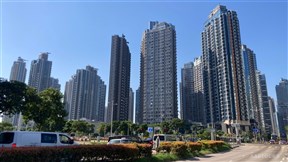
CLSA issued a report estimating that newly introduced mainland regulations on overseas investment may have a 2% to 3% negative impact on overall housing demand in Hong Kong. However, the broker believes that stabilization in the mainland property market will improve the conversion rate of mainland talent inflows into home purchase demand, thereby offsetting the impact of the above regulations and potential US rate hikes.
The report noted that the new mainland rules on overseas investment cover individual investors, although detailed implementation measures have yet to be formulated. CLSA believes that real estate is not the primary target of regulation. The broker estimates that buyers without Hong Kong identity cards account for a high-single-digit percentage of total transactions in Hong Kong, and market sentiment may affect one-third of this segment, equivalent to 2% to 3% of total transaction
volume .
Under its base-case scenario, CLSA forecasts Hong Kong residential property prices to rise by 12% in 2026, reflecting a cumulative 9% increase in the Centaline City Leading Index for secondary home prices in the first five months. Growth is expected to slow to 5% in 2027. As property price gains moderate, the relative upside may gradually shift to Chinese property stocks, particularly as valuations of Hong Kong developers have returned to normal levels.
CLSA continues to expect mainland property stocks to outperform Hong Kong developers. (ha/da)
View Original Text
This article was automatically translated by AI, the original language version should be considered the authoritative version. AASTOCKS.com Limited does not guarantee its accuracy or completeness and accepts no liability for any damages or losses arising from the use of this translation.
Comments
Interesting insights from CLSA! It makes sense that the new regulations could slightly dampen home demand, but I wonder how much the stabilization in the mainland market will really help. A 5% growth forecast for next year seems pretty conservative given the previous increases. It'll be worth watching how these dynamics play out for both Hong Kong and mainland property stocks.